Cool movie “Act of Valor” attended by cool chick with great legs in high heels, Courtney Hansen. She showed up for the movie premiere wearing a short and sassy white dress and Christian Louboutin slingback high heels. I really like this woman as she always comes to the event carpets with her “A” game showing off her smoking hot body and sexy legs in stylish and revealing attire. I’m sure the sailors in attendance for this SEAL team movie appreciated the effort.



HOLLYWOOD, CA – FEBRUARY 13: TV personality Courtney Hansen attends the premiere of Relativity Media’s “Act of Valor” at ArcLight Cinemas on February…

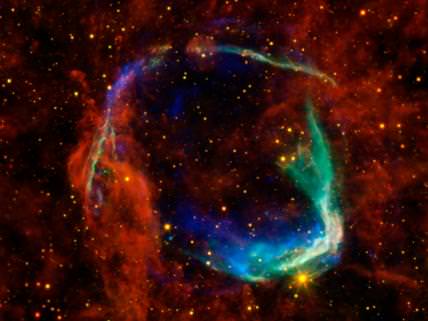 NASA – This image combines data from four space telescopes to create a multi-wavelength view of all that remains of RCW 86, the oldest documented example of a supernova. Chinese astronomers witnessed the event in 185 A.D., documenting a mysterious “guest star” that remained in the sky for eight months. X-ray images from NASA’s Chandra X-ray Observatory and the European Space Agency‘s XMM-Newton Observatory were combined to form the blue and green colors in the image. The X-rays show the interstellar gas that has been heated to millions of degrees by the passage of the shock wave from the supernova.
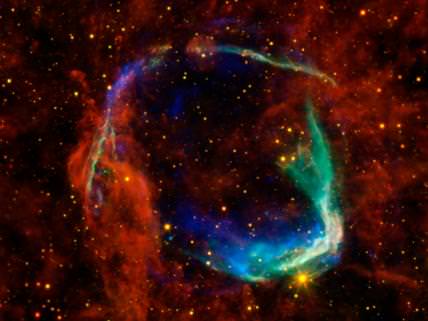 NASA – This image combines data from four space telescopes to create a multi-wavelength view of all that remains of RCW 86, the oldest documented example of a supernova. Chinese astronomers witnessed the event in 185 A.D., documenting a mysterious “guest star” that remained in the sky for eight months. X-ray images from NASA’s Chandra X-ray Observatory and the European Space Agency‘s XMM-Newton Observatory were combined to form the blue and green colors in the image. The X-rays show the interstellar gas that has been heated to millions of degrees by the passage of the shock wave from the supernova.






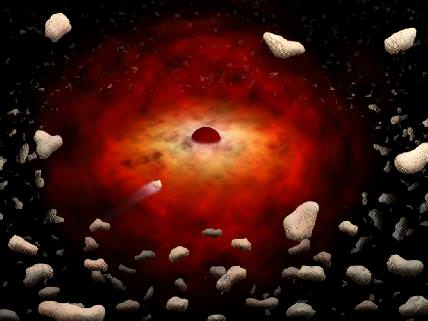 NASA – A new study provides a possible explanation of mysterious X-ray flares detected by the Chandra K-ray Observatory for several years in the region of Sagittarius A*, or Sgr A**. The study suggests a cloud around Sgr A*, a supermassive black hole at the center of our Milky Way Galaxy, which contains hundreds of trillions of asteroids and comets that have been stripped from their parent stars. The flares occur when asteroids of six miles or larger in radius are consumed by the black hole. An asteroid that undergoes a close encounter with another object, such as a star or planet, can be thrown into an orbit headed towards Sgr A*. If the asteroid passes within about 100 million miles of the black hole, roughly the distance between the Earth and the sun, it is torn into pieces by the tidal forces from the black hole. These fragments would then be vaporized by friction as they pass through the hot, thin gas flowing onto Sgr A*, similar to a meteor heating up and glowing as it falls through Earth’s atmosphere. A flare is produced and eventually the remains of the asteroid are swallowed by the black hole. Image Credit: Illustrations: NASA/CXC/M.Weiss