←
SPACE WATCH
Pink Opaque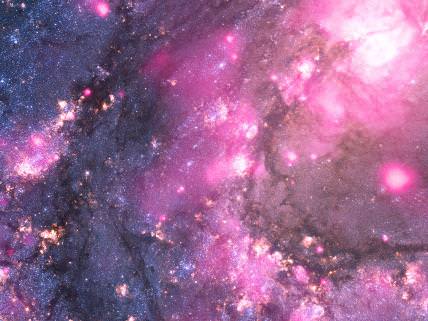 NASA – An extraordinary outburst produced by a black hole in a nearby galaxy has provided direct evidence for a population of old, volatile stellar black holes. The discovery, made by astronomers using data from NASA’s Chandra X-ray Observatory, provides new insight into the nature of a mysterious class of black holes that can produce as much energy in X-rays as a million suns radiate at all wavelengths.
Researchers used Chandra to discover a new ultraluminous X-ray source, or ULX. These objects give off more X-rays than most binary systems, in which a companion star orbits the remains of a collapsed star. These collapsed stars form either a dense core called a neutron star or a black hole. The extra X-ray emission suggests ULXs contain black holes that might be much more massive than the ones found elsewhere in our galaxy.
A paper describing these results will appear in the May 10, 2012, issue of The Astrophysical Journal. Image Credits: X-ray: NASA/CXC/Curtin University/R. Soria et al., Optical: NASA/STScI/ Middlebury College/F. Winkler et al.
Source: the Net economy




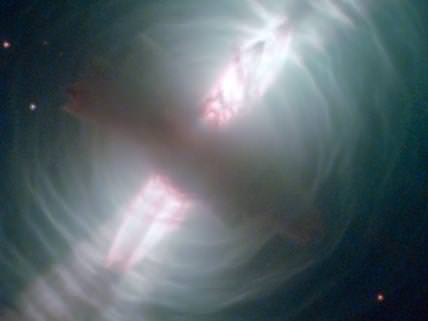 NASA – The NASA/ESA Hubble Space Telescope has been on the forefront of research into the lives of stars like our sun. At the ends of their lives, these stars run out of nuclear fuel in a phase that is called the preplanetary or protoplanetary nebula stage. This Hubble image of the Egg Nebula shows one of the best views to date of this brief, but dramatic, phase in a star’s life.
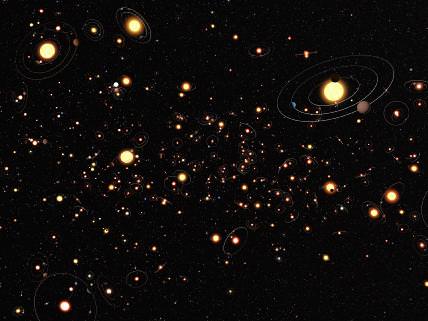 NASA – This artist’s illustration gives an impression of how common planets are around the stars in the Milky Way. The planets, their orbits and their host stars are all vastly magnified compared to their real separations. A six-year search that surveyed millions of stars using the microlensing technique concluded that planets around stars are the rule rather than the exception. The average number of planets per star is greater than one. This means that there is likely to be a minimum of 1,500 planets within just 50 light-years of Earth.

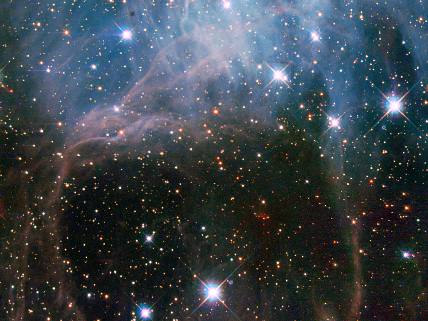 NASA – Bright stars, shining through what looks like a haze in the night sky, are part of a young stellar grouping in one of the largest known star formation regions of the Large Magellanic Cloud, a dwarf satellite galaxy of the Milky Way. The image was captured by the NASA/ESA Hubble Space Telescope‘s Wide Field Planetary Camera 2.

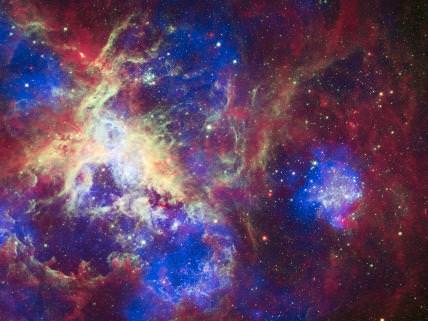 NASA – To celebrate its 22nd anniversary in orbit, the Hubble Space Telescope released a dramatic new image of the star-forming region 30 Doradus, also known as the Tarantula Nebula because its glowing filaments resemble spider legs. A new image from all three of NASA’s Great Observatories–Chandra, Hubble, and Spitzer–has also been created to mark the event.